MaRiO: Multi-agent Collaborative Reasoning via Shared Observations in MLLMs
*Equal contribution

NeurIPS 2026, Datasets and Benchmarks Track


Abstract
Multimodal Large Language Models (MLLMs) show strong visual perception capabilities, but existing evaluations largely focus on single-view or multi-view settings with shared camera parameters, leaving the challenge of multi-agent collaborative scenarios underexplored. In such settings, multiple agents observe a shared environment from independent viewpoints, and reliable decisions require reasoning across these independent observations of the same environment. To study this problem, we introduce MaRiO, a benchmark for evaluating multi-agent collaborative reasoning, and evaluate 23 state-of-the-art MLLMs on it. Our analysis reveals three key findings: (1) tasks governed by static perception are generally easier than tasks that require transformational event sequences; (2) most models struggle to resolve cross-agent correspondences, with errors increasing with scene complexity; and (3) models show limited ability to leverage geometric cues present in the scene. As an initial step toward addressing these challenges, we explore geometry-guided synthetic view augmentation that generates intermediate transition frames between agent observations, providing auxiliary spatial context that improves performance in certain categories. Overall, our results highlight that multi-agent collaborative reasoning remains an open challenge and an important direction for multimodal embodied systems.
Motivation

- Single view
- One image, so there are no frames to match.
- Multi-view
- Several images, captured along one trajectory and usually shipped with poses, intrinsics or point clouds.
- Multi-agent
- Each agent has its own egocentric frame and no shared metadata. Matching the frames is the first half of every question.
The MaRiO benchmark
Input. Two or three synchronized views and a four-choice question. No camera poses, no intrinsics, no depth, no scene graphs.
Scenes. 913 real image sets from RealEstate10K and NAVI, plus 767 synthetic sets from VirtualHome, Habitat-Sim and AI2-THOR.
Distance Awareness, Occlusion and Relative Position ask for one spatial fact once the views are matched. Egocentric Motion and Navigation ask the model to compose a transformation between frames.
Three domain-expert annotators drafted and reviewed every question, and a further annotator cross-verified them. An LLM polished phrasing and drafted distractors. Every ground-truth label is human.
Loading examples…
Results

The gap. Humans score 73.2. The best model, Gemini-2.5-Pro, stops at 55.7, which is 17.5 points short. The best open model, Qwen2-VL-7B-Instruct, gets 42.0. Chance is 23.9.
By task. Navigation and Egocentric Motion sit closest to chance. Distance Awareness and Occlusion hold up best. Models still see the scene. What they cannot do is carry a direction out of one agent's frame and into another's.
Analysis
Compositional reasoning and cross-agent correspondence


Geometric cues and the human comparison


Geometry-guided view augmentation
-
1 Agent views

-
2 Point cloud
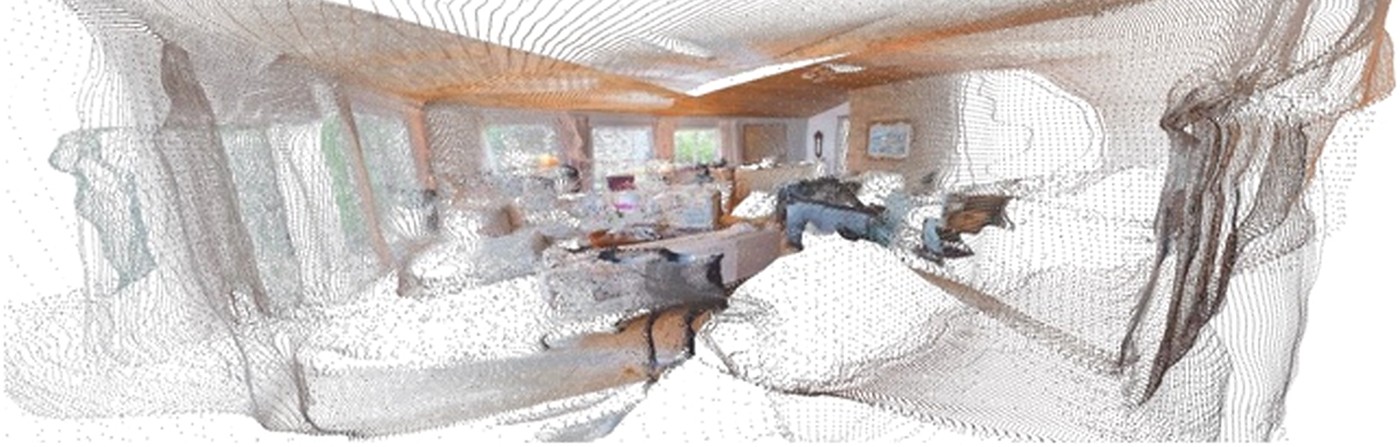
-
3 Interpolated frames

-
4 Novel views
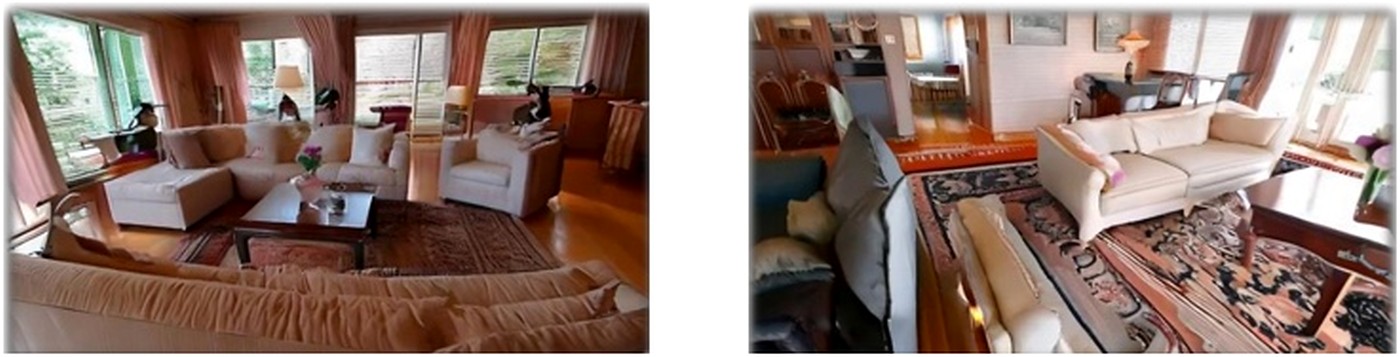


Geometry-guided view synthesis, in four stages.

Setup. A diffusion video model turns the rendered in-between frames into novel views. They go in as extra context for the same question, and no new agent is added.
Effect. Qwen2.5-VL-7B gains 1.1 overall, with 4.5 on Occlusion and 3.9 on Relative Position. Spatially trained models gain nothing or lose ground, which the paper reads as the generated frames introducing small geometric inconsistencies. Twelve frames is the best setting, and cropping real frames instead does not reproduce the gain, so what helps is the new viewpoint and not the extra pixels.